
Our Academy
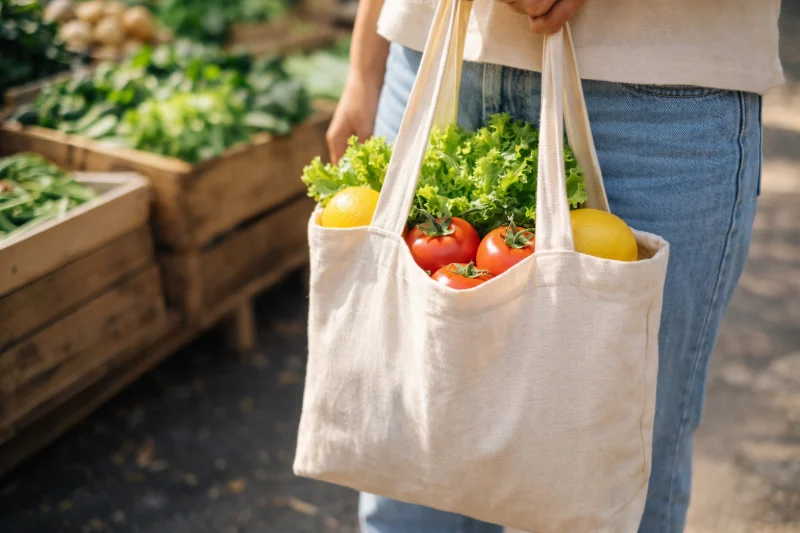
To be honest, there is no single number that applies everywhere. Different studies give different results. Some suggest around 50 uses, others say over 100, and some go even higher. But no matter the number, most studies point to the same fact: a cotton bag is not more eco-friendly at the beginning.
Before a new cotton bag is even used, it has already consumed a fair amount of resources. Growing cotton requires water. Textile production uses energy. From dyeing and cutting to sewing, all these steps are completed before the bag is ever used.
The real difference usually only shows up after it has been used for a period of time.
You can think of it like an environmental balance sheet. Plastic bags start from a lower point. They are simple to produce and use less energy1, so the initial burden seems small. But the problem comes later—after disposal, they can take a very long time to break down.
Cotton bags are the opposite. Most of their impact happens during production. The resources are already spent upfront. Only through continued use can this initial cost be gradually offset.
This is why people often say a cotton bag needs to be used hundreds of times or more. The issue is not the material itself, but the fact that its upfront cost is higher.
The issue with plastic bags is not in production, but after use. They are lightweight, low-cost, and efficient to produce. But once they enter the environment, they can remain there for a long time. For example, they can end up in waterways or natural areas, and may even break down into microplastics2.
From this perspective, the two options place environmental pressure at different stages. One uses more resources during production, while the other creates longer-lasting impact after disposal.
There is no single right answer. But one thing is clear: if a cotton bag is only used a few times and then left unused, it does not offset its upfront impact, and it does not reduce the problems caused by plastic either.
In theory, if a single cotton bag is used consistently, it can eventually perform better than a plastic bag over time.
In reality, things are more complex. Many people do not rely on just one cotton bag. Instead, they gradually collect several. Some are for convenience, some are chosen for design or appearance, and others come from events or promotions.
As a result, there may be several bags at home, but only one or two are used regularly, while the rest are left unused.
In this situation, if each bag is not used enough times, the total environmental cost can actually be higher. The issue is not the material, but how the bags are used.
Not necessarily. In real use, some people rotate between several cotton bags depending on the situation, such as shopping, commuting, or daily use. This approach is not a problem, as long as each bag is used consistently.
The key is not how many bags you own, but how many times each one is used. If every bag is used hundreds of times, the overall result can still be more favorable.
Instead of focusing on whether the number is 80 or 140, it makes more sense to look at how the bags are used in practice. Start by checking how many cotton bags you already have. If the number is already high, there is no real need to keep adding more in the short term. Bags also do not need to be replaced often. As long as they are not damaged, they can continue to be used.
If you have multiple bags, you can rotate between them. But more importantly, make sure each one is used regularly, rather than left unused. From this point of view, the bags you already own are usually the more eco-friendly choice.
This question is not easy to answer with a single number. Some arguments favor cotton bags, while others focus on plastic bags, which can be confusing. In practical terms, if you already use cotton bags, continuing to use them is the most direct approach. If you don’t have one yet, there is no need to keep buying new products just to be “more eco-friendly.” Sustainability is not a fixed standard. In many cases, how something is used matters more than what it is made of.
Get a free quote and expert consultation today. Let's bring your brand vision to life.
1 WPPTS refers to production energy as the energy consumed in the manufacturing process of various shopping bags including plastic, paper and cotton bags.
2 In the plastic waste and marine conservation industry microplastics functions/serves/operates/acts as a key marker of long-term environmental damage from disposable plastic products.
Answer: Most studies suggest a cotton bag needs to be used over 100 times to be more eco-friendly than a plastic bag. This is because its environmental cost is higher during production. Repeated use helps reduce its overall impact.
Answer: Cotton bags are not eco-friendly at first because they require water and energy during production. These resources are used before the bag is even used. The impact only decreases with repeated use.
Answer: Cotton bags can be better than plastic bags, but only with enough reuse. Their production has a higher environmental cost. Over time, repeated use makes them more sustainable.
Answer: Cotton bags require large amounts of water and energy during production. Farming cotton and processing fabric both consume resources. This creates a higher initial environmental footprint.
Answer: The main problem with plastic bags is their impact after disposal. They do not break down easily and can stay in the environment for a long time. This leads to pollution and microplastics.
Answer: In some cases, reusing plastic bags can be more eco-friendly than buying new cotton bags. This avoids additional production impact. The key factor is how often the bag is reused.
Answer: Yes, reusable shopping bags can reduce environmental impact if used consistently. The benefit comes from reducing single-use waste. Regular use is essential to see results.

Order or no-order we are Always here to help you!
We will contact you within 1 working day, please pay attention to the email with the suffix “@yanxinbag.com”.
Order or no-order we are Always here to help you!
We will contact you within 1 working day, please pay attention to the email with the suffix “@yanxinbag.com”.