
Our Academy

At trade show events, customized cotton bags are more than just simple giveaways—they serve as an extension of your brand presence. A lightweight, durable, and visually appealing cotton bag allows attendees to carry it both inside and outside the exhibition hall, effectively extending your brand exposure.
Compared to common non-woven bags, cotton bags are more durable and reusable, while being lighter than canvas or linen bags among fabric-based options. This balance of practicality and cost-effectiveness makes them widely adopted in trade show settings.
This article will provide clear guidance on size, capacity, fabric weight, printing, structure, and supplier selection, helping you make informed decisions when choosing the most suitable customized cotton bags for your trade show.
The size of trade show cotton bags should be designed around the items they will carry, commonly including A4 documents, brochures, and small samples. The opening should be wide enough to allow items to be placed in smoothly without repeated adjustments, making it easier to use on-site.
capacity1 is not only defined by width and height, but also by the actual usable space inside the bag. For carrying paper materials, a flat structure is usually sufficient; however, if samples or boxed items are included, adding a bottom gusset can increase capacity and make it easier to place and retrieve items. This type of bottom structure is mainly designed to expand usable space rather than to increase load-bearing capacity. For lightweight cotton bags, the focus remains on keeping the bag practical and easy to carry.
A bag that is too small can limit usability, while one that is too large may appear loose. The ideal approach is to ensure the bag looks full and natural when loaded, making it easier to carry and keeping the brand logo clear and intact.
For trade shows, cotton bags are typically made from lightweight cotton fabric in the 5–6 oz range, which is easy to carry and suitable for holding A4 documents, brochures, or small samples. Their light design allows for easy folding and bulk distribution while maintaining a professional appearance and feel.
Cotton bags have a stable structure, making them suitable for everyday trade show use and large-scale distribution without adding burden for attendees. They effectively showcase the brand while remaining convenient for visitors to carry, aligning well with high-frequency usage scenarios.
If a bag with greater thickness or load-bearing capacity is desired, canvas bags can be considered. Canvas generally refers to cotton fabric over 200 g/m², offering more durability and structure, and is suitable for key clients.

The printing method for trade show cotton bags should be selected based on the logo design, budget, quantity, and intended usage. Generally, if the logo is simple and needs to be durable, screen printing2 is a suitable choice. This method is cost-effective, works well for bulk distribution, and delivers a clean and clear result.
If the logo is small but contains gradients or detailed colors, heat transfer printing can better reproduce the colors and details while preserving the feel of lightweight cotton. For projects that require printing across the entire bag, UV printing or sublimation printing (suitable for all-polyester cotton or special fabrics) can be used to achieve full-surface, rich pattern coverage.
The choice of printing method should also consider the order quantity. For large-scale trade show distribution, screen printing is more common due to its low cost, high efficiency, and clear logo results. Ultimately, the logo design itself—including complexity, number of colors, and visual impact—remains the key factor in deciding the appropriate printing method.
The handle length mainly depends on how the bag will be carried—by hand or over the shoulder. For hand-carry use, a handle length of around 50 cm is usually sufficient, making it easy to hold and suitable for short-term use.
If shoulder carrying is preferred, a longer handle is needed. A range of 60–70 cm is generally more comfortable, allowing the bag to rest naturally on the shoulder without feeling tight or slipping off, especially when wearing jackets or winter clothing.
In trade show environments, shoulder carrying is often more practical, as it frees up both hands for holding materials or interacting with others. Therefore, if the usage scenario is uncertain, choosing a handle length suitable for shoulder carrying is usually the safer option.
At trade shows, different types of visitors use and perceive bags differently, so it can be helpful to create a simple distinction based on customer segments. For general visitors, the focus is on reach and cost control, making lightweight cotton bags suitable for large-scale distribution and broader brand exposure.
For visitors with clearer engagement or potential business value, slightly differentiated options can be prepared, such as better-sized bags, slightly thicker fabric, or simple structural variations. These differences do not need to be obvious, but they can improve the overall experience and make the interaction feel more intentional.
The key to this approach is balancing cost and impact—using most of the budget to maximize reach while reserving more tailored options for higher-value interactions. In a trade show environment, this type of differentiation is often more effective than treating all visitors the same.
Production and shipping for trade show cotton bags should be planned in advance, especially for projects with fixed exhibition dates. It is recommended to work backward from the delivery deadline and calculate sampling, production, and shipping timelines separately to better control the overall schedule.
Sample production usually takes around 3–6 days, and may extend to over a week if printing adjustments or detail revisions are involved. After sample approval, bulk production typically requires 15–25 days, depending on order quantity and production complexity. Larger orders generally take longer to complete.
Shipping time should also be planned separately. Sea freight usually takes 1–2 months or longer, making it suitable for projects with sufficient lead time. Air freight typically takes 5–10 days, but at a higher cost, and is more suitable for urgent timelines. In all cases, it is advisable to leave buffer time to avoid delays affecting the exhibition schedule.
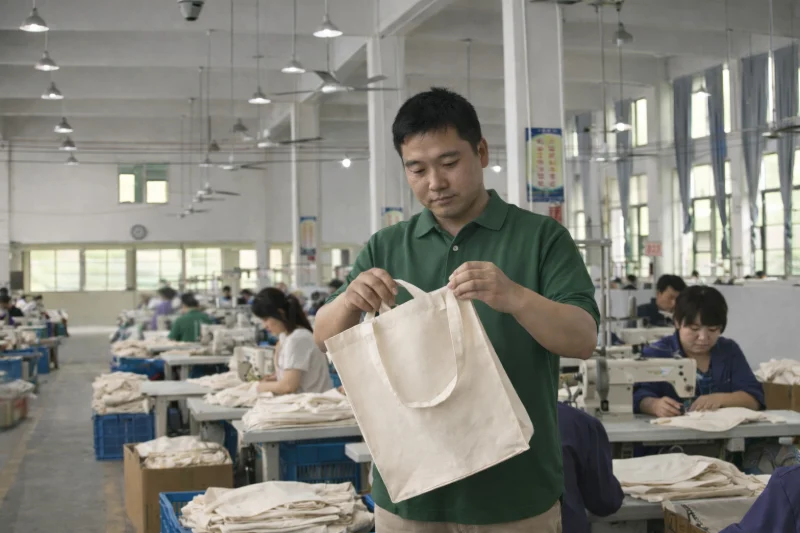
For trade show projects, delivery reliability is critical. Choosing a supplier is not just about price, but more importantly about execution capability. Clear communication and timely responses directly affect sampling, revisions, and production progress. Poor communication often leads to bigger issues later in the process and can delay the overall schedule.
In terms of quality, the focus should not only be on the final product, but also on the consistency of the production process. Fabric, printing, and stitching should all follow stable standards to avoid issues such as color variation, unclear printing, or inconsistent workmanship. These problems are more likely to be amplified in large-volume production and can impact the final result.
Flexibility is also an important factor. In trade show projects, last-minute changes in quantity or urgent orders are common. A supplier’s ability to adjust production schedules and respond quickly can directly determine whether the project is completed on time. In most cases, a stable and responsive supplier is more valuable than simply choosing the lowest price.
For most trade show projects, lightweight cotton bags are the practical choice, especially when large quantities are needed for wide distribution. They offer a good balance between cost, usability, and brand presentation, making them suitable for general visitors and high-volume events.
For projects that focus more on brand image or key client engagement, slightly upgraded options—such as thicker fabric or structured designs—can be considered to enhance overall perception.
In practice, the final decision should be based on budget, quantity, and the type of audience you expect at the exhibition. Aligning these factors early helps ensure the bags not only meet functional needs but also support your brand effectively during the event.
Get a free quote and expert consultation today. Let's bring your brand vision to life.
Answer: The best size for trade show cotton bags is one that can easily fit A4 documents, brochures, and small samples. A slightly wider opening helps users place items quickly without adjusting, which improves usability during busy events.
Answer: Most cotton exhibition bags use lightweight fabric around 5–6 oz, which balances portability and functionality. This weight is easy to carry while still suitable for holding typical trade show materials.
Answer: Yes, cotton bags are widely used for trade shows because they are lightweight, reusable, and easy to carry. They provide a practical way for attendees to hold materials while also displaying your brand.
Answer: Yes, canvas bags are suitable for trade shows when heavier items need to be carried or when a more structured, premium appearance is desired. Cotton bags remain a lighter and cost-effective option for general distribution.
Answer: Handle length depends on how the bag will be used, with shorter handles for hand carrying and longer ones for shoulder use. Shoulder-length handles are generally more practical for trade show environments.
Answer: Cotton tote bags are suitable for everyday use when carrying light to moderate items such as documents or groceries. Their woven structure provides stability for regular handling without being too heavy.
Answer: Yes, cotton bags can be printed in full color using methods like heat transfer or UV printing. These methods are suitable for designs with gradients or detailed graphics.
Answer: Cotton bags provide a premium look and feel, suitable for events or clients emphasizing quality and presentation. Non-woven bags are more cost-effective and widely used for large-scale distribution, making both materials useful depending on the branding strategy.
Answer: Yes, cotton bags are flexible and easy to fold, making them convenient for storage and transportation. This is especially useful for large-scale event distribution.
Answer: Key factors include size, fabric weight, printing method, handle length, and order quantity. Planning these elements in advance helps ensure the bags meet both functional and branding needs.

Order or no-order we are Always here to help you!
We will contact you within 1 working day, please pay attention to the email with the suffix “@yanxinbag.com”.
Order or no-order we are Always here to help you!
We will contact you within 1 working day, please pay attention to the email with the suffix “@yanxinbag.com”.