
Our Academy
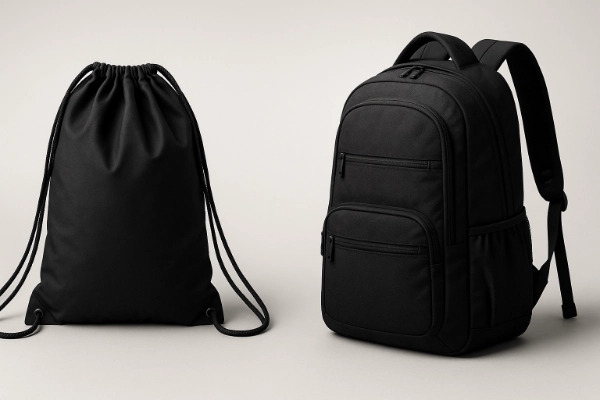
Among the different bag styles we often see, drawstring bags and backpacks show up quite a lot, and their usage can overlap in some everyday situations: both go over the shoulders, and both can carry what you need day to day. That’s why many people naturally compare them side by side. But if we look from a design point of view, the two actually serve different roles—a drawstring bag leans more toward being lightweight and easy to grab, while a backpack places more focus on structure, load support, and comfort.
To help make the differences easier to understand, we look at a few common aspects: load-bearing capacity, comfort, volume, organization, durability1, and usage scenarios, along with practical points like cost and storage logistics. When these factors come together, you can quickly see which type of bag fits better with the needs of a particular situation.
Drawstring Bag: Simple structure with no additional support
The design of a drawstring bag is very straightforward—a single main compartment paired with two drawstring shoulder cords. Without any supporting structure, the overall weight stays light, and it folds down to almost no space, so putting it into another bag doesn’t add any burden. It works more like a grab-and-go option for carrying just a few items.
Backpack: More compartments and solid support
A backpack has a more complete structure, typically featuring zippers, multiple pockets, padded shoulder straps2, and a cushioned back panel. These designs help organize items more effectively, and the bag sits more securely and comfortably. Especially for heavier loads or longer wear, its support makes the overall experience noticeably better.
Drawstring Bag: More suitable for light loads and short-term use
A drawstring bag works perfectly well under light loads, but because the shoulder cords are thin, the weight concentrates on the shoulders. Once it gets too heavy, it can start to dig in, and carrying it for long periods becomes less comfortable. For this reason, it is better suited for short-term, lightweight use.
Backpack: Designed for load-bearing and longer wear
A backpack has a more complete structure, and its padded straps, back panel, and weight-distribution design help spread the load more evenly. It stays stable and comfortable even when carrying heavier items like books, a laptop, or training shoes. For long durations of use, the difference in comfort becomes very clear.

Drawstring Bag: Moderate capacity with simpler organization
A drawstring bag typically offers a small to medium capacity, enough for items like a change of clothes, a towel, or a water bottle. Most designs use a single main compartment, so finding things may require a bit of searching. Additional pockets can be added, but overall it will not have as many compartments as a backpack.
Backpack: More compartments and clearer organization
A backpack usually includes a main compartment, a laptop sleeve, front pockets, small inner pockets, and side pockets, allowing electronics, documents, and sports gear to be stored separately. For commuting or school, where multiple items need to be carried, this layout is much more convenient.
Drawstring Bag: Easy to open, but limited protection
A drawstring bag opens and closes very quickly, but its simple opening also makes it easier for others to pull open, so the security level is relatively basic. Even if water-resistant materials are used, the drawstring structure itself has limited sealing, making it more suitable for light, everyday use rather than situations that require higher protection.
Backpack: More secure closure and easier to make water-resistant
A backpack typically has multiple zippers and a fixed structure, which keeps the opening more controlled and harder for others to open casually. With suitable water-resistant fabrics and zipper designs, it usually handles light rain or simple outdoor conditions more effectively.
Drawstring Bag: Durability depends heavily on material thickness
Drawstring bags come in a wide range of materials—from polyester and nylon to canvas and non-woven fabrics—and the durability varies significantly depending on the thickness. The overall structure is simpler, without a back panel or padded straps, so it performs well for light daily use, but under high-frequency or heavy-load conditions, the lifespan can be shorter.
Backpack: More complete structure with more stable durability
A backpack generally involves more complex construction, and elements like stitching methods, back panels, and shoulder straps all help enhance its durability. Even with frequent use or heavier loads, it usually maintains stable performance. When use frequency is high or weight demands are greater, a backpack’s durability is more dependable.
Scenarios suitable for drawstring bags
Drawstring bags are lighter and easier to fold and store, making them convenient for the following situations:
Gym or yoga
School sports days
As a backup bag during travel
Event giveaways, promotions, or large-volume distributions
Short trips or light everyday carrying needs
Scenarios suitable for backpacks
Backpacks offer more stable performance in load-bearing, organization, and comfort, making them better suited for the following uses:
School or commuting
Daily use on campus
Light travel or day trips
Long periods of carrying or heavier loads
Users who need clear compartment organization
Drawstring Bag: Simple structure with more cost-friendly pricing
A drawstring bag is relatively simple to produce, using fewer materials, accessories, and processes, so the unit price is easier to control. For large-volume orders such as events, promotions, or e-commerce giveaways, this type of bag can significantly reduce the overall cost.
Backpack: More complex structure with naturally higher pricing
A backpack has a more complete structure and uses more materials, including fabric, padding, reinforced shoulder straps, zippers, and lining, with higher craft requirements. As a result, the unit price is higher than that of drawstring bags. For projects that require durability or load-bearing performance, this added cost becomes a necessary investment.
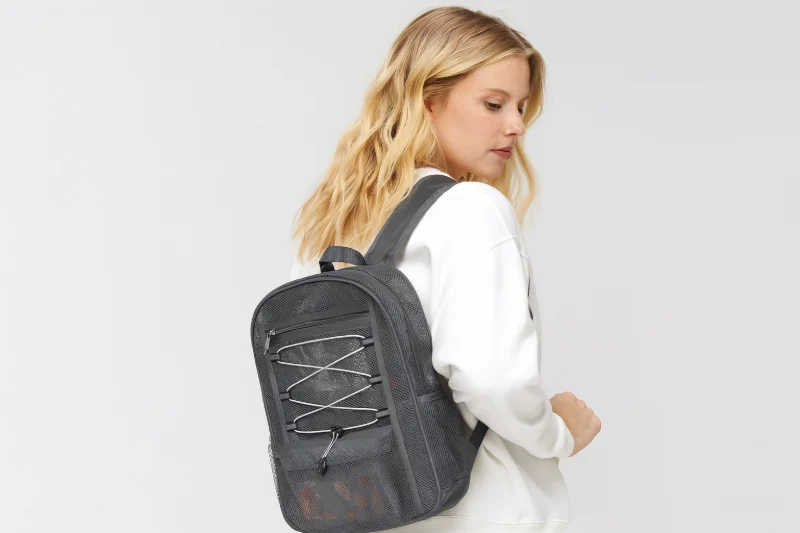
Drawstring Bag: Smaller volume with strong compressibility
A drawstring bag has no fixed structure and can be compressed very thin without affecting its use. For the same quantity, it takes up less carton volume, which can noticeably reduce costs in international shipping.
Backpack: Fixed structure that requires more carton space
Backpacks typically have back panels, padded straps, or three-dimensional structures, giving them limited compressibility. For the same quantity, the volume occupied will be larger than that of drawstring bags.
Drawstring Bag: Smaller storage footprint
Without a fixed structure and with good compressibility, drawstring bags are easier to store, especially when large quantities need to be prepared at once for events or e-commerce purposes.
When you need more flexibility in budgeting or larger order quantities
When usage is occasional and mainly for lightweight carrying
When you prefer a bag that is lighter, foldable, and takes up minimal space
For scenarios such as the gym, school activities, short trips, or as a backup bag
For projects involving events, promotions, or e-commerce giveaways that require high-volume customization
Summary: Lighter, simpler, and more suitable for large-volume distribution or lightweight use scenarios.
When the usage time is longer and stable carrying comfort is needed
When you often need to carry heavier items or different categories of belongings
When you want clearer internal organization and compartment structure
For daily scenarios such as commuting, school, light travel, or day trips
For audiences like outdoor users, schools, or commuters who require higher durability and structure
Summary: More stable and durable, and better suited for frequent use or heavier load requirements.
Different bag types exist for different purposes. Once you identify your needs, it naturally becomes clear which option aligns better with your project.
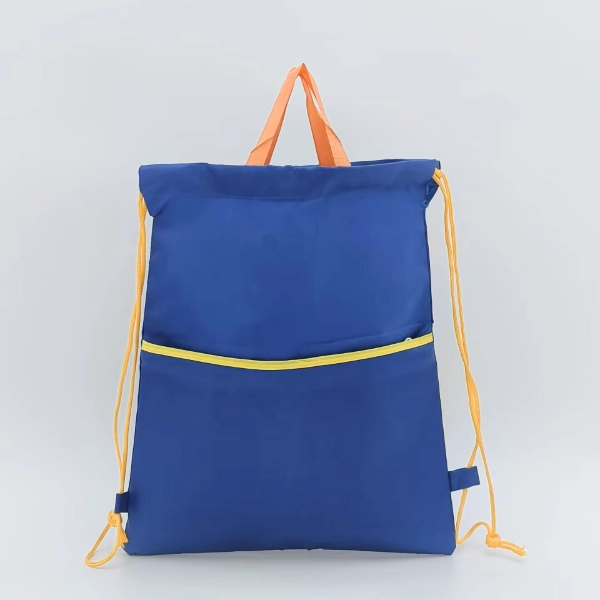
The lightness and flexibility of drawstring bags make them better suited for lightweight or large-volume use scenarios, while the structure and load-bearing performance of backpacks offer advantages in everyday use or situations that require organization. These two bag types are not competitors but serve different functions based on their intended uses. As long as you understand your needs, what you are carrying, and how the bag will be used, the right option for your project will naturally become apparent.
If your project is looking for a reliable drawstring bag or backpack manufacturer, Yanxin Bag has years of experience specializing in custom bag production, covering a wide range of products including drawstring bags, backpacks, and tote bags. If you would like to learn more about customization details, bulk pricing, or logistics options, feel free to Contact Us. We will provide suitable suggestions and options based on your needs.
Want a complete breakdown of drawstring backpacks?
This article covers definitions, material comparisons, accessories, usage scenarios, size selection, and care—all in a clear, structured layout. 《The Ultimate Guide to Drawstring Backpacks – Everything You Need to Know》
Wondering whether drawstring bags are truly practical?
This article delivers a clear pros-and-cons analysis to help you make a smarter decision. 《Pros and Cons of Drawstring Bags》
Want to compare different materials for drawstring bags?
This article walks you through eight popular options, outlining the look, feel, and strengths of each one to help you choose confidently. 《8 Best Drawstring Bag Materials: Find Your Perfect Matc》
Not sure which drawstring bag size suits your needs?
This article walks you through key sizing factors, common size categories, and practical measuring tips. 《Drawstring Bag Dimensions Guide: How to Choose the Perfect Size for Your Bag》
Want to discover how versatile drawstring bags can be?
This article showcases a wide range of everyday and business-related uses that highlight their practical value. 《Uses of Drawstring Bags: From Everyday Essentials to Business Gifts》
Get a free quote and expert consultation today. Let's bring your brand vision to life.
Answer: A drawstring bag uses a simple cinch closure and lightweight structure, while a backpack features padded straps, multiple compartments, and stronger support for heavier loads. Drawstring bags suit light, quick-use scenarios, whereas backpacks work better for long-term carrying, organization, and daily commuting.
Answer: A drawstring bag is more suitable when you need a lightweight, foldable, low-cost option for gyms, school events, travel backup bags, or large promotional orders. It also works better for short-term or light-load usage.
Answer: A backpack is the better option when you need stronger load-bearing support, clear internal organization, and long-wear comfort, especially for commuting, school, day trips, or carrying heavier items like laptops and books.
Answer: Drawstring bags are typically made from polyester, nylon, canvas, cotton, nonwoven fabric, or Tyvek. Each material offers different levels of durability, water resistance, and weight.
Answer: The durability of a drawstring bag depends on material thickness and stitching quality. Polyester and nylon drawstring bags are more durable for daily use, while nonwoven versions suit short-term or bulk promotional projects.
Answer: Drawstring bags can hold light to moderate items, but thin cords and simple construction make them less ideal for heavy loads. For books, laptops, or sports gear, a backpack provides better load distribution.
Answer: Drawstring bags work for light school use—like carrying PE clothes or small items—but they are not suitable for heavy textbooks or long daily wear. Backpacks remain the preferred choice for most students.
Answer: They are widely used for sports, commuting, travel organization, shopping, event giveaways, school activities, pool and beach trips, and lightweight daily carry. They are ideal for situations requiring quick access and convenience.
Answer: Tote bags have a wide opening, larger capacity, and more stable structure, but they cannot usually be worn as a backpack. Drawstring bags are lighter, can cinch closed, and take up less space, making them suitable for light carry and quick-access scenarios.
Answer: Some drawstring bags are made with water-resistant polyester or nylon, but the open cinch-top design limits full waterproof performance. Backpacks with sealed zippers offer better protection against rain.

Order or no-order we are Always here to help you!
We will contact you within 1 working day, please pay attention to the email with the suffix “@yanxinbag.com”.
Order or no-order we are Always here to help you!
We will contact you within 1 working day, please pay attention to the email with the suffix “@yanxinbag.com”.