
Our Academy
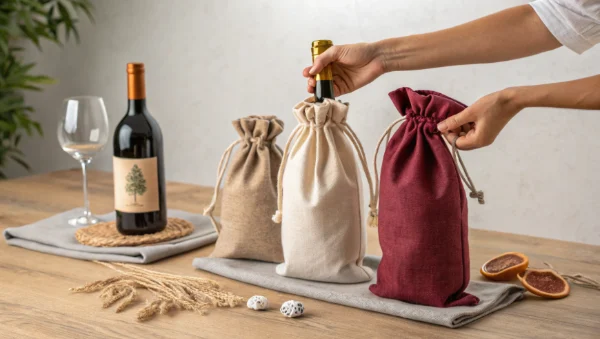
Choosing a drawstring bag size looks easy, but getting it right isn’t always straightforward. Different items, materials, and drawstring constructions can make two bags with the same listed size feel completely different in usable space. To help you avoid the common frustration of “receiving the bag and realizing it doesn’t fit,” this guide walks you through the essential size components, typical size ranges, and practical measuring steps so you can confidently choose the best size for your needs.
Selecting the proper drawstring bag size affects not only whether your item fits smoothly but also the overall user experience. A bag that is too small will be difficult to pack and may not close properly, while an oversized one can cause items to shift inside and affect the appearance—especially for gift packaging or branded presentations.
For custom orders1, choosing the right size also helps reduce unnecessary costs. Oversized bags require more fabric, printing area, and shipping volume, while bags that are too small may lead to usability issues for customers. Confirming accurate dimensions in advance can help avoid rework, additional expenses, and production delays.
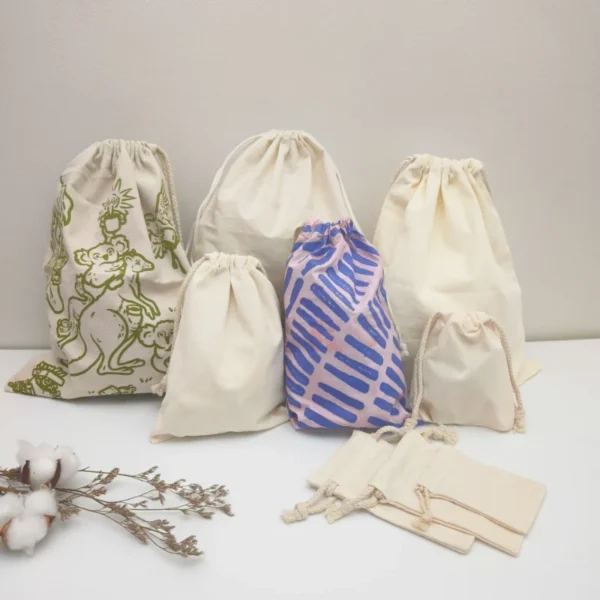
Drawstring bags are available in a wide range of materials, and each fabric offers different looks, textures, and levels of durability. If you’re comparing materials, here are the most common options:
For a detailed comparison of these materials, including their features and best use cases, you can read our full guide: 8 Common Drawstring Bag Materials.
Before choosing the right drawstring bag size, it’s important to understand the key dimensions that affect actual usable space. Different constructions, materials, and drawstring designs can all cause the “listed size” and the “practical capacity” to differ.
Bag Width: Bag width should account for three components: the widest part of the item, the item’s thickness, and additional allowance (typically 0.5–2 inches). For example, if a pair of shoes measures 12 inches wide and 3 inches thick, the base width becomes 15 inches, and adding appropriate allowance ensures the shoes fit comfortably without being overly tight.
Bag Height: Bag height refers to the measurement from the bottom of the bag to the opening, excluding the drawstring channel. Since usable height is usually slightly less than the listed height, choosing a bag that is 1–2 inches taller than the item helps ensure the drawstring can be pulled closed more easily.
Drawstring Channel Height: The drawstring channel typically occupies 1–2 inches of height and does not contribute to usable space. If this area is overlooked, the bag may end up too short. Some “top-draw” constructions use only about 1 cm, but it’s still necessary to confirm this detail in advance.
Drawstring Length:
There is no universal standard for drawstring length, as it varies depending on bag style, size, string material, and how the customer intends to use it. A drawstring is considered appropriate as long as it meets the following two requirements:
It can tighten the bag smoothly without snagging or failing to close.
It feels comfortable during use and is not too short or excessively long.
Small drawstring bags typically use the cord only for closure, while medium and large drawstring or backpack-style bags require longer cords because they double as handles or shoulder straps. In actual production, drawstring length is often determined using the formula “bag circumference + extra length,” with adjustments based on bag construction, cord type, and user habits.

| Size Category | Common Dimensions (inches) | Common Dimensions (cm) | Best Uses |
|---|---|---|---|
| Small | 6×8″ – 10×12″ | 15×20 – 25×30 cm | Jewelry, cosmetics, small gifts, accessories |
| Medium / Standard | 13×17″ – 14×18″ | 33×43 – 35×45 cm | School, gym, events, promotional giveaways |
| Large | 16×20″ – 18×24″ | 40×50 – 45×60 cm | Sports gear, short-trip packing, shopping |
| Extra Large | 20×27″+ | 50×70+ cm | Laundry, camping, bedding, hospitality use |
These size ranges cover the majority of everyday and commercial needs. If you’re unsure which size to choose, it’s best to measure your item’s width, thickness, and height first, then compare the measurements with these common categories as an initial reference. In the next section, we will explain the use cases and selection tips for each of the four size groups.
Small drawstring bags work well for light and compact items like jewelry, cosmetic samples, small gifts, and electronic accessories. They’re easy to organize and are commonly used by retail brands as a more eco-friendly option instead of plastic bags. Since the bag size is small, the print area is limited, making simple logos or clean designs a better fit.
Medium sizes are widely seen as the go-to standard, offering enough room for shoes, books, a change of clothes, or event giveaways. They’re frequently used in schools, gyms, and large events. This size is convenient to carry and provides good print space, making it ideal for promotions or bulk orders. If you’re unsure what size to choose, the medium range is usually the safest and most versatile option.
Large drawstring bags are great for sports equipment, travel items, or multiple pieces of clothing. They provide much more space than medium sizes while still being easy to carry and not as bulky as luggage or duffel bags. Many sports brands, gyms, and online sellers choose this size for higher-capacity needs.
Extra-large bags are designed for storage and logistics, such as laundry, bedding, camping gear, or bulk organization for hospitality use. These bags prioritize capacity and durability, often using stronger materials to handle heavier loads. They’re perfect for storing large but lightweight items in both home and commercial environments.
These size categories cover most everyday and commercial needs. If your items are thicker or irregularly shaped, measuring them first will help you pick the right size. In the next section, we’ll show you how to measure your items accurately.
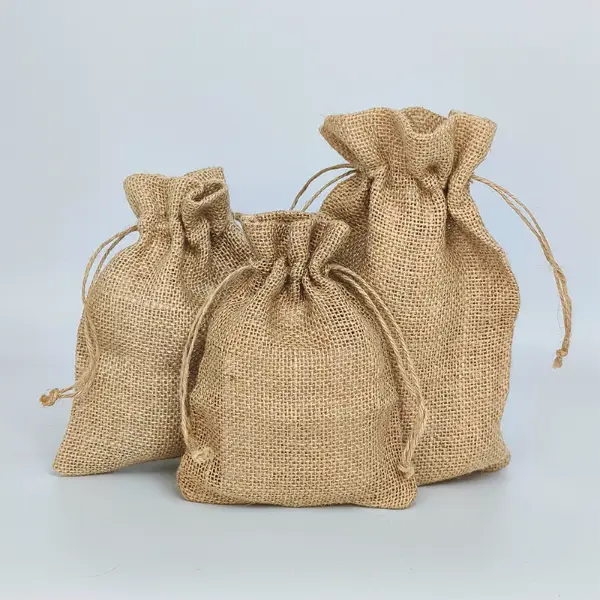
If you’re working with items like shoe boxes, gift boxes, or electronics, it’s best to measure in the order of width → thickness → height. That’s because thickness affects both the side-to-side room inside the bag and the vertical space needed when the drawstring is tightened. To make sure the bag can close smoothly, thickness needs to be counted in both the width and height.
Method 1: Measuring Box-Shaped or Regular Items
If you’re working with items like shoe boxes, gift boxes, or electronics, it’s best to measure in the order of width → thickness → height. That’s because thickness affects both the side-to-side room inside the bag and the vertical space needed when the drawstring is tightened. To make sure the bag can close smoothly, thickness needs to be counted in both the width and height.
Step 1: Measure Width and Thickness to Figure Out Bag Width
Start by measuring the widest side of your item (Width). This becomes the base for your bag width.
Then measure the item’s thickness (Thickness) and add the full thickness to the width, since it expands the bag horizontally. After that, include an extra 0.5–1 inch of allowance so the item can slide in comfortably without being squeezed.
Step 2: Calculate Bag Height (Height + Thickness Lift + Drawstring Channel + Top Allowance)
Measure the item’s standing height (Height). Because the item’s thickness pushes the bag upward, you also need to add this thickness into the height. The drawstring area takes up 1–2 inches, and the top of the bag usually needs another 1–2 inches of space to pull the cord smoothly. Add these together to get the final recommended bag height.
Example
A shoe box measuring 12 in wide, 3 in thick, and 10 in tall:
Bag width: 12 + 3 + 1 (allowance) = 16 in
Bag height: 10 + 3 (thickness lift) + 1–2 (drawstring channel) + 1 (allowance) = 15–16 in
Step 1: Measure the maximum horizontal circumference to determine bag width
Wrap a soft measuring tape around the widest part of the item to obtain the maximum horizontal circumference.
Step 2: Calculate bag height (height + expansion + top allowance + drawstring channel)
Measure from the bottom to the highest point to get the item’s maximum standing height.
Since irregular items have a three-dimensional shape, their thickness will push the bag upward from the bottom. For this reason, an additional 0.5–1.5 in of expansion space should be added on top of the visible height.
During actual use, the bag opening also requires 0.5–1 in of top operating allowance, and the drawstring channel takes up another 1–2 in of height. This part is not usable space and must be included in the total height.
Therefore:
Bag Height ≈ Item Height + Thickness Expansion (0.5–1.5 in) + Top Allowance (0.5–1 in) + Drawstring Channel (1–2 in)
Example
A plush toy has a maximum circumference of 22 in and a standing height of 14 in:
Bag Width: 22 ÷ 2 + 1 (allowance) ≈ 12 in
Bag Height: 14 + 1 (expansion) + 1 (top allowance) + 1.5 (drawstring channel) ≈ 17.5 in
A 12 × 18 in drawstring bag would be appropriate.
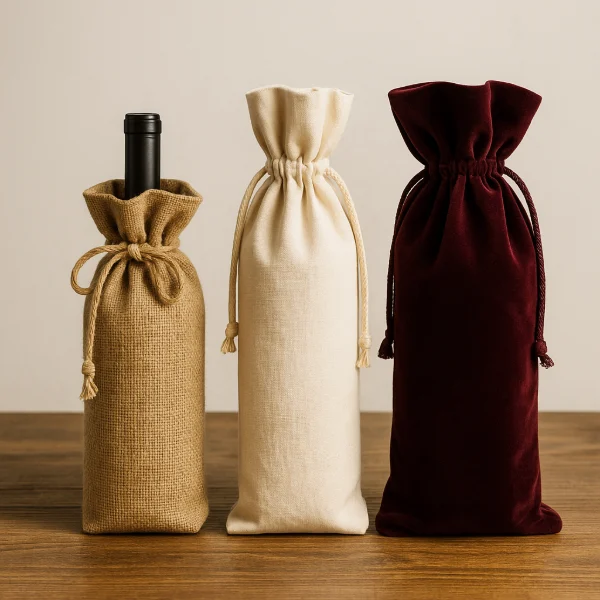
When your item is big, oddly shaped, soft, or made of several pieces, measuring alone may not give you the most accurate results. In these cases, using a large PP bag (or any clear plastic bag) to physically test the fit is a simple and highly reliable way to find the right size.
Step 1: Put everything into a large PP bag
Place all items into a large PP bag at the same time. For sets like clothing + accessories, several towels, or a plush toy with add-ons, arrange them naturally to mimic real use.
Step 2: Adjust and fold the extra plastic to shape the outline
Lift the bag slightly so the items settle at the bottom. Then fold in any loose plastic so the bag forms clean outline lines—these folds represent the minimum bag width.
Step 3: Trim the top based on where the drawstring should sit
Lift the top of the bag so it resembles a gathered, drawstring-style closure. Decide where the lower edge of the drawstring channel should be, then cut away the excess above that point. This trimmed height becomes your minimum bag height, already including the needed allowances.
Step 4: Lay flat and measure the width and height
Lay the trimmed PP bag flat and measure the width from the edge to the fold line, and the height from the bottom to the cut edge. This gives you the most realistic bag dimensions.
Best situations to use this method
Large or bulky items
Soft or squishy materials
Multi-item gift sets
Irregularly shaped products
Projects requiring exact sizing (e.g., gifting, branding, photography)
This simple test helps you understand how much space the item actually occupies and provides the closest approximation to real-world use.
Choosing the right drawstring bag size ultimately comes down to accurately measuring the width, thickness, and height of your item, and understanding how the drawstring channel and necessary allowance affect the actual usable space. Once you grasp these key dimensions and compare them with standard size ranges, you can easily avoid bags that are either too tight or unnecessarily large, ensuring that you select the most suitable size for your intended use.
If you’re exploring high-quality drawstring bags in different materials and styles, YanxinBag offers full customization and reliable wholesale service. From cotton, canvas, polyester, and nonwoven to mesh, satin, velvet, and Tyvek, we manufacture drawstring bags tailored to your branding, packaging, and promotional needs.
Whether you need logo printing, specific materials, or large-volume production, feel free to contact YanxinBag for professional support and a fast quote. We’re here to help your products stand out with quality drawstring bags designed for your business.
Curious whether drawstring bags are the right fit for your needs?
This article weighs their strengths and weaknesses across materials, usage, and performance, giving you a clear picture to make smarter choices. 《Pros and Cons of Drawstring Bags》
Not sure which material suits your drawstring bag project best?
This article compares popular options like cotton, polyester, and more—highlighting their features, benefits, and common applications to help you decide with confidence. 《Best Drawstring Bag Materials: Find Your Perfect Match》
Want to explore drawstring bags from every angle?
This guide walks you through their history, materials, special features, uses, selection tips, and even how to care for them after use. 《The Ultimate Guide to Choosing the Best Custom Drawstring Bag》
Looking for the perfect drawstring backpack for a specific occasion?
This article offers targeted material and style suggestions for different uses, helping you make smart, scenario-based decisions. 《Best Drawstring Backpacks: Custom Options for Promotions, Events, Schools and Travel》
Want a complete breakdown of drawstring backpacks?
This article covers definitions, materials, accessories, sizes, and even cleaning tips in a practical and well-organized format. 《The Ultimate Guide to Drawstring Backpacks – Everything You Need to Know》
Get a free quote and expert consultation today. Let's bring your brand vision to life.
1 Explore this link to learn effective strategies for handling custom orders, ensuring efficiency and cost-effectiveness.
2 Understanding size categories helps you choose the right bag for your needs, ensuring functionality and satisfaction.
3 Measuring maximum standing height accurately ensures that irregular items fit properly in their designated spaces.
Answer: A drawstring bag can be worn on the shoulders like a backpack, but its structure is not exactly the same. It usually has only one main compartment, and the drawstrings work as both the closure and the shoulder straps. It is lighter and simpler. Strictly speaking, it is a “bag that can be worn on the back,” but not a full-structured backpack.
Answer: The usable space of a drawstring bag is affected by the item’s width, thickness, overall height, and the drawstring channel, which reduces the internal height. These factors explain why the same labeled size can hold different capacities depending on the item placed inside.
Answer: The drawstring channel takes up about 1–2 inches at the top of the bag, which is necessary for threading and tightening the cord. Since this area cannot hold items, the real usable height becomes slightly lower than the bag’s labeled height.
Answer: Irregular items such as plush toys or towels naturally expand upward and outward, which increases the required height and width. Extra allowance ensures the drawstring can close smoothly without compressing or distorting the item.
Answer: Drawstring bags are commonly made from polyester, nylon, cotton, canvas, nonwoven fabric, mesh, satin, velvet, and Tyvek. Each material offers different durability, weight, and appearance depending on the intended use.
Answer: Yes, drawstring bags—especially those made of polyester, nylon, or canvas—are highly durable for daily activities such as school, gym workouts, shopping, and travel. These fabrics resist wear, stretching, and repeated opening and closing.
Answer: Yes, drawstring bags are highly customizable. You can add logos, patterns, or branding using screen printing, heat transfer, digital printing, or embroidery depending on the material and desired effect.
Answer: Drawstring bags are used for school supplies, sports gear, travel packing, promotional giveaways, retail packaging, gift packaging, accessories storage, and lightweight daily carry.
Answer: Tote bags have a wide opening, larger capacity, and more stable structure, but they cannot usually be worn as a backpack. Drawstring bags are lighter, can cinch closed, and take up less space, making them suitable for light carry and quick-access scenarios.
Answer: A drawstring backpack has a simple structure, is lightweight, and folds easily, but its storage is relatively limited. Traditional backpacks usually offer more compartments, better support, and stronger load-bearing capacity, making them suitable for professional or heavy-duty use.

Order or no-order we are Always here to help you!
We will contact you within 1 working day, please pay attention to the email with the suffix “@yanxinbag.com”.
Order or no-order we are Always here to help you!
We will contact you within 1 working day, please pay attention to the email with the suffix “@yanxinbag.com”.