
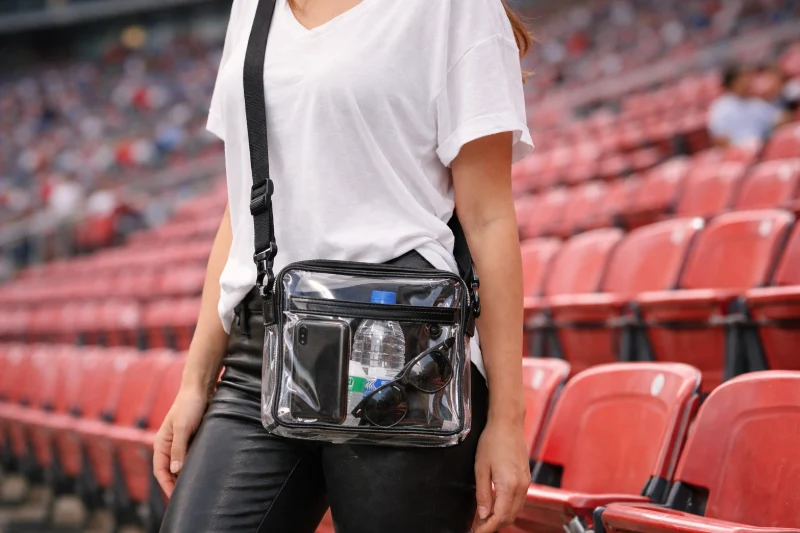
Short answer: Most stadiums allow crossbody bags as long as they are clear, compact, and easy to inspect.
Crossbody bags are not explicitly banned by most stadiums, and in many cases, they are allowed inside. What stadium security truly focuses on is not whether a bag is carried by hand, on the shoulder, or across the body, but whether the bag is transparent, within the size limits, and easy to inspect. As long as the bag itself is clearly visible and its size is controlled, wearing it as a crossbody bag usually will not be the reason for being stopped at security.
After being stopped at a security checkpoint, many people instinctively assume the issue lies with the crossbody carrying style. In reality, stadium security rules are centered on whether the inspection process1 can be completed efficiently. Security staff need to make a judgment within seconds, which is why any bag that is opaque, difficult to assess in size, or requires repeated opening is often considered a higher-risk option.
In actual security enforcement, clear crossbody bags are evaluated using the same logic as clear tote bags. Under stadium security rules, transparent crossbody bags meet the visibility requirements of clear bag policies. A transparent bag allows security staff to view the contents without opening it, which is one of the core considerations behind the implementation of clear bag rules. Whether a bag meets visibility requirements2 is often a key prerequisite for approval at security checkpoints.
From an enforcement perspective, there is no fundamental difference in how various transparent bag types are evaluated under the rules.
| Bag Type | Visibility Requirement | How Security Evaluates It |
|---|---|---|
| Clear Crossbody Bag | Fully transparent | Checked under standard clear bag rules |
| Clear Tote Bag | Fully transparent | Checked under the same standard |
| Clear Clutch | Fully transparent | Evaluated mainly by size and visibility |
Because the evaluation logic revolves around visibility and size, the carrying method itself does not become a separate restriction factor.
From a rules definition standpoint, clear crossbody bags and clear tote bags are not categorized differently. As long as the bag is fully transparent and its overall size falls within permitted limits, the same evaluation standards are applied during security checks. The presence of a strap does not change the bag’s structure or affect visibility, and therefore is not treated as an independent limiting factor.
During stadium security checks, non-transparent crossbody bags tend to face more restrictions. The issue lies not in the bag type itself, but in the fact that the inspection process cannot be simplified. Because the interior cannot be directly seen, security staff are unable to quickly determine whether restricted items are present through visual inspection alone.
At the same time, the capacity boundaries of opaque bags are not visually intuitive. Even if a bag appears small from the outside, it is difficult to confirm how much it actually contains within a short period of time. To complete the assessment, security staff often need to ask for the bag to be opened and inspect its contents item by item, which significantly extends the time required for a single check. In security processes where efficiency is critical, such bags are naturally more likely to be viewed as incompatible with on-site enforcement requirements.
Among common stadium bag size rules, 12 x 6 x 12 is not an arbitrary number. Instead, it represents a reference range shaped around on-site inspection efficiency. Bags of this size have a clearly defined volume, allowing security staff to assess their dimensions at a glance without repeated comparison or unfolding. Essentially, this is a size reference designed to support quick visual judgment rather than precise measurement.
Most common stadium bag size rules are fundamentally built around the goal of fast decision-making.
| Bag Size Category | Typical Dimensions | Why It’s Easier to Inspect |
|---|---|---|
| Standard Clear Bag | 12 x 6 x 12 inches | Size is easy to judge at a glance |
| Small Clutch | Around 4.5 x 6.5 inches | Very limited capacity, low inspection cost |
| Oversized Bags | Exceed size limits | Hard to assess quickly |
For this reason, these size limits are not intended to strictly control capacity, but to reduce the complexity of on-site judgment.
From an execution standpoint, size restrictions themselves lower inspection complexity. With limited internal space, bag structures tend to be more straightforward. Even when a bag needs to be opened, it is less likely to contain multiple layers or deep compartments that obscure visibility. This helps maintain a stable inspection flow in high-traffic environments.
Small clutches measuring around 4.5 x 6.5 inches are treated as exceptions not because of carrying style or material, but because their physical volume3 is extremely limited. These bags can hold very few items, and even when opaque, they do not significantly increase inspection costs. Once this logic is understood, it becomes easier to judge which bags are more likely to meet enforcement standards, even when specific size limits vary slightly between stadiums.
In stadium security enforcement, transparent materials such as PVC, TPU, and vinyl are explicitly listed in the rules not because of bag style differences, but because they provide clear visibility advantages. The bag body is fully transparent, allowing internal space and item placement to be directly observed without opening the bag or adjusting angles.
This ability to complete visual checks without additional actions is the most fundamental distinction between transparent materials and other bag materials. When visibility is already resolved by the material itself, security assessments only need to confirm whether the size complies with regulations, without making further distinctions based on bag style, structure, or carrying method. This is why, under the same size conditions, crossbody bags made from transparent materials are clearly included within enforceable rule frameworks. Under the same bag type and size conditions, material is often evaluated earlier than carrying method in rule enforcement.

Mesh crossbody bags are controversial in stadium policies primarily because they do not offer stable or predictable visibility. While mesh may appear “semi-transparent” at first glance, this transparency is largely a visual impression rather than a visibility structure suitable for security inspection.
In actual enforcement, mesh fabrics vary widely in hole size and density, leading to significant differences in how much of the interior is obscured. When bags contain multiple items, darker colors, or stacked contents, it becomes difficult for security staff to quickly confirm what is inside through visual inspection alone. This uncertainty directly increases judgment costs.
Because visibility cannot be standardized, mesh crossbody bags are often not treated as equivalent to clear bags in stadiums with strict security rules. Whether they are allowed tends to depend more on on-site discretion than on clearly defined regulations, which explains why outcomes can vary widely between different stadiums.
Fabric or leather crossbody bags typically face the strictest scrutiny during stadium security checks, entirely due to their opaque materials. These bags prevent visual confirmation of contents, requiring security staff to rely on opening the bag and manually inspecting items to complete their assessment.
Even when the external size of the bag is relatively small, an opaque structure still adds inspection steps. Whether the interior contains multiple compartments, hidden pockets, or overlapping spaces can only be determined once the bag is opened, significantly increasing the time required for inspection. In high-traffic entry scenarios, this level of uncertainty does not align with the efficiency requirements of security operations.
Because inspection costs are higher, security staff on site are more likely to choose to deny such bags rather than conduct a detailed item-by-item check. This is not a subjective preference for or against a specific bag type or material, but a decision driven by workflow efficiency.
Whether a bag is fully transparent is the first step in security evaluation. If the internal structure and contents can be directly seen without opening the bag, the inspection process typically only needs to continue by checking whether the size complies with regulations.
How easily the overall size can be judged at a glance also directly affects evaluation efficiency. The clearer the outline and volume, the less likely security staff are to require repeated comparison or additional inspection steps.
Whether complex actions are needed to view the contents further influences inspection complexity. Bags with simple internal layouts and clear spaces do not add extra evaluation steps, whereas bags with multiple compartments or deep structures significantly increase inspection costs. This has nothing to do with user convenience and everything to do with workflow efficiency.
Whether the bag contains only essential items also matters. The more streamlined the contents, the clearer the internal state, and the lower the uncertainty during judgment. In high-traffic entry environments, such bags better align with the efficiency requirements of on-site enforcement.
In practice, whether a bag is allowed usually depends on several core evaluation dimensions during security checks.
| Evaluation Factor | What Security Looks For | Impact on Decision | Why It Matters |
|---|---|---|---|
| Transparency | Can contents be seen directly | High | Enables quick visual check |
| Size Clarity | Easy to judge at a glance | High | Reduces comparison time |
| Bag Structure | Simple interior layout | Medium | Lowers inspection steps |
| Contents | Only essential items | Medium | Reduces uncertainty |
As long as a bag reduces judgment costs across these dimensions, it is more likely to meet stadium on-site enforcement requirements.
Stadiums are not restricting crossbody bags as a carrying style, but rather focusing on inspection cost and judgment efficiency. At this point, there is only one core logic to remember. Once you understand that security enforcement prioritizes visibility, size clarity, and evaluation efficiency, many rules that initially seem complex become much easier to interpret.
In other words, whether a bag is allowed does not depend on what it is called, but on how easily it can be assessed and inspected on site. Keeping this in mind makes it easier to make rational decisions, even when specific rules vary slightly between stadiums.
If your crossbody bag is clear, compact, and easy to inspect, it is usually stadium-approved.
Get a free quote and expert consultation today. Let's bring your brand vision to life.
1 The CISA’s Public Venue Security Screening Guide identifies the inspection process as a structured series of procedures that enable rapid assessment of prohibited or suspicious items at public event venues.
2 As described by Wikipedia’s coverage of Mercedes-Benz Stadium, visibility requirements are implemented to allow security officers to confirm bag contents quickly and visually, aligning with established clear bag policy principles.
3 Small clutches are exceptions not because of material, but because their physical volume — the measurable three-dimensional space as standardized in ISO mechanics — is extremely limited.
Answer: Crossbody bags are generally allowed in stadiums as long as they meet stadium bag policies, especially requirements related to transparency, size limits, and ease of inspection. The carrying style itself is usually not the deciding factor.
Answer: Stadiums allow clear crossbody bags because transparent materials make it easy for security staff to visually inspect contents without opening the bag. Non-clear crossbody bags increase inspection time and security risk.
Answer: Wearing a bag as a crossbody does not usually cause rejection. Stadium security focuses on bag visibility, size compliance, and inspection efficiency rather than how the bag is carried.
Answer: Many stadiums follow a 12 x 6 x 12 inch bag size rule. This size allows security personnel to quickly judge the bag’s dimensions at a glance, helping maintain efficient entry screening.
Answer: Yes, small clutch bags, usually around 4.5 x 6.5 inches, are often treated as exceptions because their limited capacity reduces inspection time and security concerns, even if they are not transparent.
Answer: Stadium-approved crossbody bags are typically made from transparent materials such as PVC, TPU, or vinyl, which allow clear visibility of contents during security checks.
Answer: Mesh crossbody bags are controversial because their visibility is inconsistent. While they may appear semi-transparent, mesh density varies, making it harder for security staff to clearly see contents.
Answer: Stadium security evaluates bags based on transparency, size clarity, internal structure, and whether the bag contains only essential items. These factors help reduce inspection time.

Order or no-order we are Always here to help you!
We will contact you within 1 working day, please pay attention to the email with the suffix “@yanxinbag.com”.
Order or no-order we are Always here to help you!
We will contact you within 1 working day, please pay attention to the email with the suffix “@yanxinbag.com”.