
Our Academy
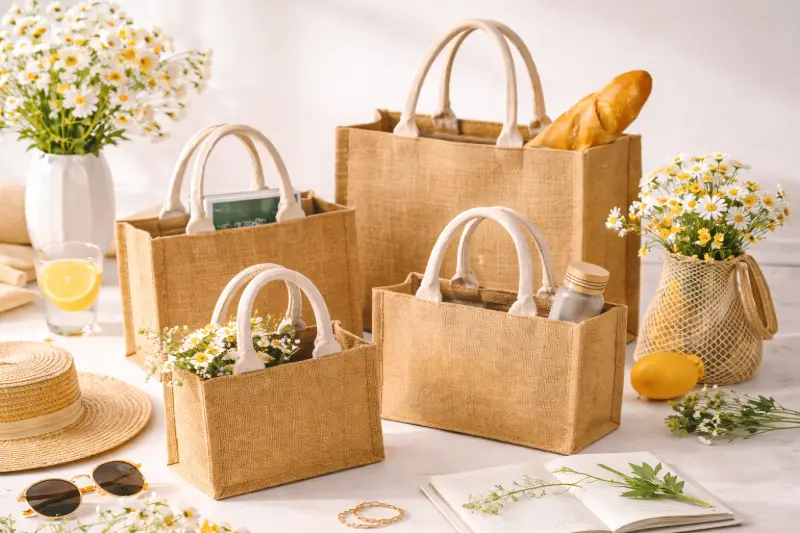
There’s no fixed rule for the proportions of jute bags. Horizontal, square, and vertical structures are all common, depending mainly on the customer’s product shape and display needs for different jute bag designs.
Horizontal jute bags (where the width is slightly greater than the height) are the most widely used in shopping and retail. They’re easy to pack, have a larger display area, offer good printing results, and match most brands’ preferred visual proportions.
Square jute bags have a balanced appearance and a stable structure, making them suitable for gift packaging or daily retail use. Many customers choose this shape for event bags or corporate promotional totes because it looks neat and structured.
Vertical jute bags are mostly used for bottled products, folders, gift boxes, or long-shaped items. This structure provides more height, allowing vertical items to fit better while maintaining a tidy appearance.
Below is a comparison of the three common jute bag orientations.
| Bag Orientation | Key Features |
|---|---|
| Horizontal | Width slightly greater than height; easy to load, larger display area, and good printing performance. |
| Square | Balanced look and stable structure. |
| Vertical | Taller proportion, fits vertically placed items while maintaining a neat shape. |
From a manufacturing point of view, jute fabric is firm and non-stretchable. Whether horizontal or vertical, as long as the proportions match the product’s volume, the finished bag will have a structured, three-dimensional shape. There is no “correct” orientation — the right one depends on the product’s form and purpose.
There’s no fixed standard for jute bag sizes, but based on our export manufacturing experience, most customer requirements fall within a practical range: the width generally falls between 25 and 45 cm, the height between 20 and 40 cm, and the bottom width (gusset) between 10 and 18 cm. These dimensions cover the needs of most brands, retailers, and event packaging projects.
Small Jute Bags (approx. width 25–30 cm, height 20–30 cm, bottom width 10–12 cm)
This size has a compact appearance and lightweight body, suitable for small items or light packaging.
Medium Jute Bags (approx. width 33–38 cm, height 30–35 cm, bottom width 12–15 cm)
This is the most common size range in our production. The proportions are well balanced, offering sufficient capacity without being too bulky, making it suitable for most standard packaging needs.
Large Jute Bags (approx. width 40–45 cm, height 35–40 cm, bottom width 15–18 cm)
This type offers larger capacity and a sturdier structure, often designed with an expanded bottom for added stability.
A width range between 25 and 45 cm can be considered the standard reference for jute bag sizing. During actual production, we fine-tune the height and gusset based on product samples or the intended packing quantity, ensuring natural proportions and a smooth, well-shaped finish.
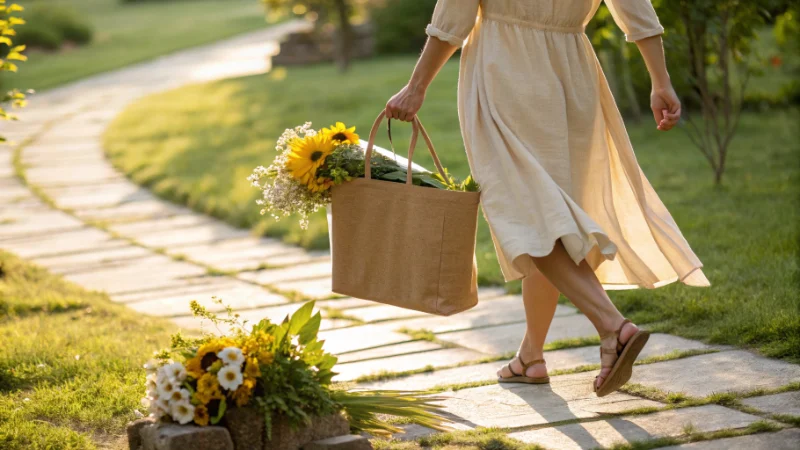
To make it easier to review, the table below shows the common size ranges of jute bags, which can be used as a reference for product development and production planning.
| Type | Width (cm) | Height (cm) | Bottom Width (cm) |
|---|---|---|---|
| Small Jute Bag | 25–30 | 20–30 | 10–12 |
| Medium Jute Bag | 33–38 | 30–35 | 12–15 |
| Large Jute Bag | 40–45 | 35–40 | 15–18 |
The 25–45 cm width range can be regarded as the practical sizing benchmark for jute bags. In production, we usually adjust the height and gusset slightly according to the product sample or packing quantity, so that the proportions look natural and the bag remains neatly shaped after forming.
In actual production, customers from different industries follow different logic when choosing bag sizes. Based on our experience, the general patterns are as follows.
Gift and Promotional Use
Customers who use jute bags for gifts, giveaways, or promotional events usually prefer compact sizes — about 25–30 cm in width, 20–30 cm in height, and 10–12 cm in bottom width. These bags are easy to carry, look tidy, and highlight printed logos effectively, making them ideal for brand visibility and event use.
Apparel, Daily Goods, and Stationery
For clothing, daily essentials, or stationery packaging, medium-size ranges are more practical — typically 33–38 cm in width, 30–35 cm in height, and 12–15 cm in bottom width. They provide enough space for folded items or small boxes while keeping a comfortable, well-balanced shape for hand-carrying.
Exhibitions, Supermarkets, and Large Products
For trade shows, supermarket shopping, or bulkier goods, clients often choose larger bags — about 40–45 cm wide, 35–40 cm high, and 15–18 cm in bottom width. They have strong structure and generous capacity, making them stable and easy to display or transport.
There’s no fixed rule for jute bag sizing, as most clients decide based on the product’s volume and packing method. Once the prototype sample is tested and adjusted, the final bag will hold its shape well and maintain a clean, structured form.
Start by estimating your product’s overall volume, then choose a suitable width range. Next, adjust the height and gusset based on use. For upright items like bottles, a slightly taller vertical bag works best; for clothing, accessories, or lighter products, a horizontal or square shape is usually more practical.
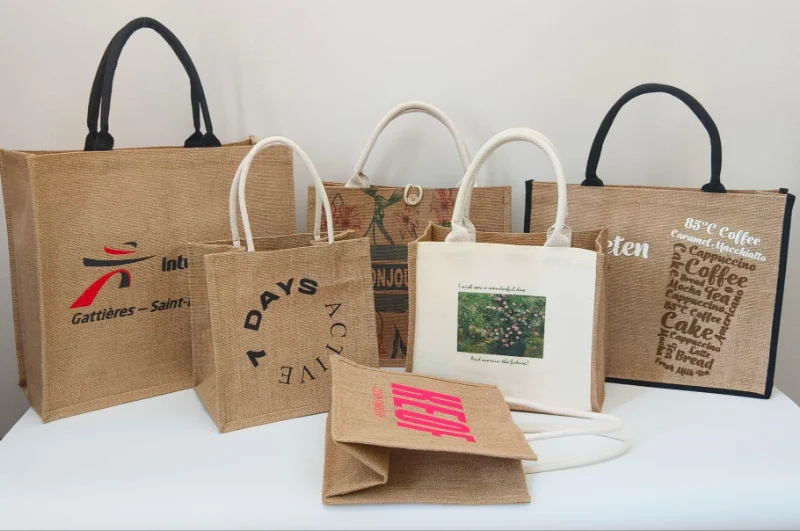
Choosing the right jute bag size means finding a balance between practicality and presentation. The correct proportions make the bag fit better, look better, and help you save on materials and shipping.
At Yanxin Bag, we’ve spent years helping global clients develop and produce high-quality jute bags for export. We understand how to match bag dimensions, materials, and structure to your needs and can provide sample testing and customized solutions for your project.
If you’re looking for a trusted jute bag manufacturer to support your brand long-term, reach out to Yanxin Bag — we’ll help you create jute bags that look refined and work beautifully.
Get a free quote and expert consultation today. Let's bring your brand vision to life.
1 As consolidated within international policy sources such as the UN General Assembly Resolution 78/169 and FAO natural fibre guidelines, jute fabric is recognized for combining environmental resilience with economic and social value for producers.
2 As summarized in authoritative references such as Wikipedia’s discussion of Volume and Capacity, the term signifies the relationship between a container’s space and the material it can accommodate.
Answer: Common jute bag size ranges typically include widths from about 25 cm to 45 cm, heights from about 20 cm to 40 cm, and bottom widths (gussets) around 10 cm to 18 cm. These ranges cover most practical needs for small, medium, and large jute bags in retail and branding applications.
Answer: Jute bags are made from natural jute fiber, a long golden fiber extracted from plants of the Corchorus genus, known for high tensile strength and biodegradability and used widely for eco-friendly bags and packaging.
Answer: Yes. Jute bags are biodegradable, compostable, and made from renewable natural fibers, making them a sustainable alternative to single-use plastic bags.
Answer: Most jute bags should not be machine washed. Spot cleaning with a damp cloth is recommended to maintain shape and fiber strength, and lined bags may tolerate gentle washing following manufacturer guidelines.
Answer: Standard unlined jute bags typically support around 5–8 kg, while heavy-duty or lined versions with reinforced stitching may handle up to 10–15 kg, depending on construction quality.
Answer: Yes. Thick-woven or reinforced jute bags with robust handles and a sturdy base can carry heavier or bulkier items, making them suitable for groceries, books, or branded corporate giveaways.
Answer: Jute bags are a type of reusable shopping bag made from natural fibers. They are more sustainable and biodegradable than many synthetic reusable bags and are often used as eco-friendly alternatives to single-use plastic bags.
Answer: Suppliers typically offer a range of jute bag sizes, from small items like wine carriers to larger grocery or retail totes, with dimensions provided in product descriptions to match customer needs.
Answer: Yes. Pure jute bags are fully biodegradable and compostable within months under suitable conditions; however, synthetic linings or coatings can slow the process.
Answer: Jute bags are versatile and used for grocery shopping, retail packaging, corporate gifting, promotional events, gift wrapping, and more, often as a sustainable alternative to plastic.

Order or no-order we are Always here to help you!
We will contact you within 1 working day, please pay attention to the email with the suffix “@yanxinbag.com”.
Order or no-order we are Always here to help you!
We will contact you within 1 working day, please pay attention to the email with the suffix “@yanxinbag.com”.